FLEETLY
Architecting a 0→1 Operational Ecosystem to Drive Billing Transparency and Scale Enterprise Efficiency
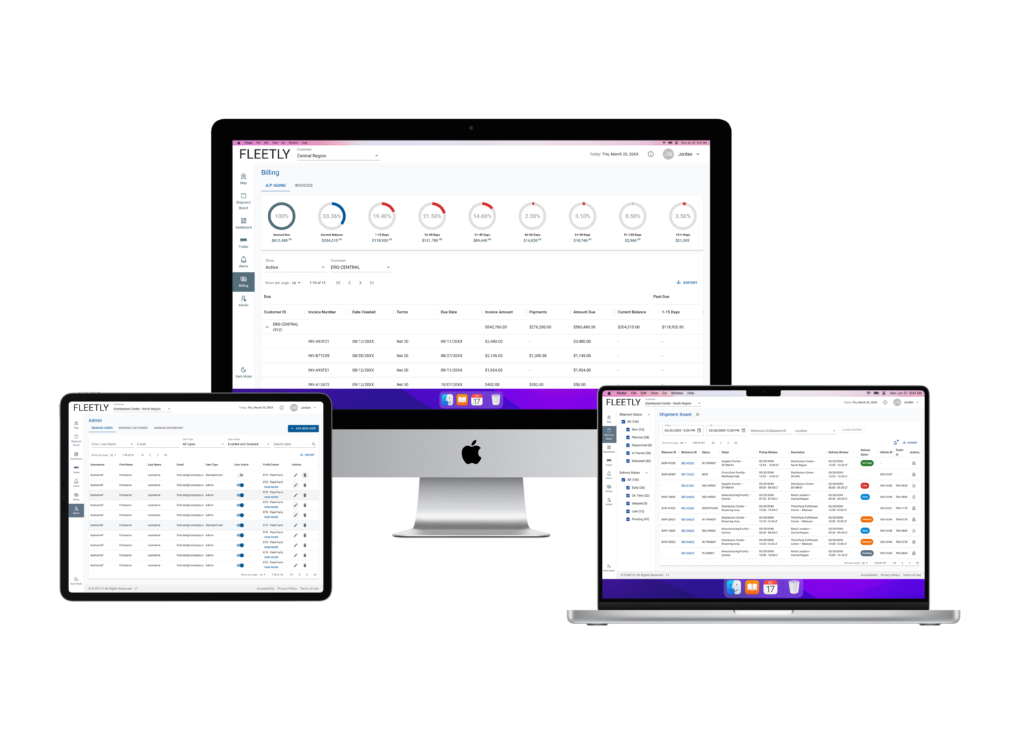
Logistics operations teams often relied on multiple disconnected systems to track shipments, monitor alerts, and verify billing. Fleetly unifies these workflows into a single operational platform that supports both customers and internal operations teams.
My Role: Product Design Lead | IA | 0→1 Enterprise SaaS
Operational Efficiency
Streamlined high-density workflows to reduce errors by 38% and accelerate operational decision-making.
Billing Transparency
Architected financial visibility systems to mitigate revenue leakage and improve audit accuracy.
Technical Edge
Applied a CS background to architect production-ready components, accelerating engineering velocity and system consistency.
Product Strategy
Consolidated fragmented systems into a single source of truth , improving usability by 65%.
Project Overview
Fleetly is an enterprise logistics platform that provides customers and operations teams with real-time visibility into shipment activity, fleet performance, and billing operations.
The platform consolidates several critical operational workflows into a single system, allowing teams to track shipments, monitor fleet activity, manage billing, and configure administrative settings without switching between multiple tools.
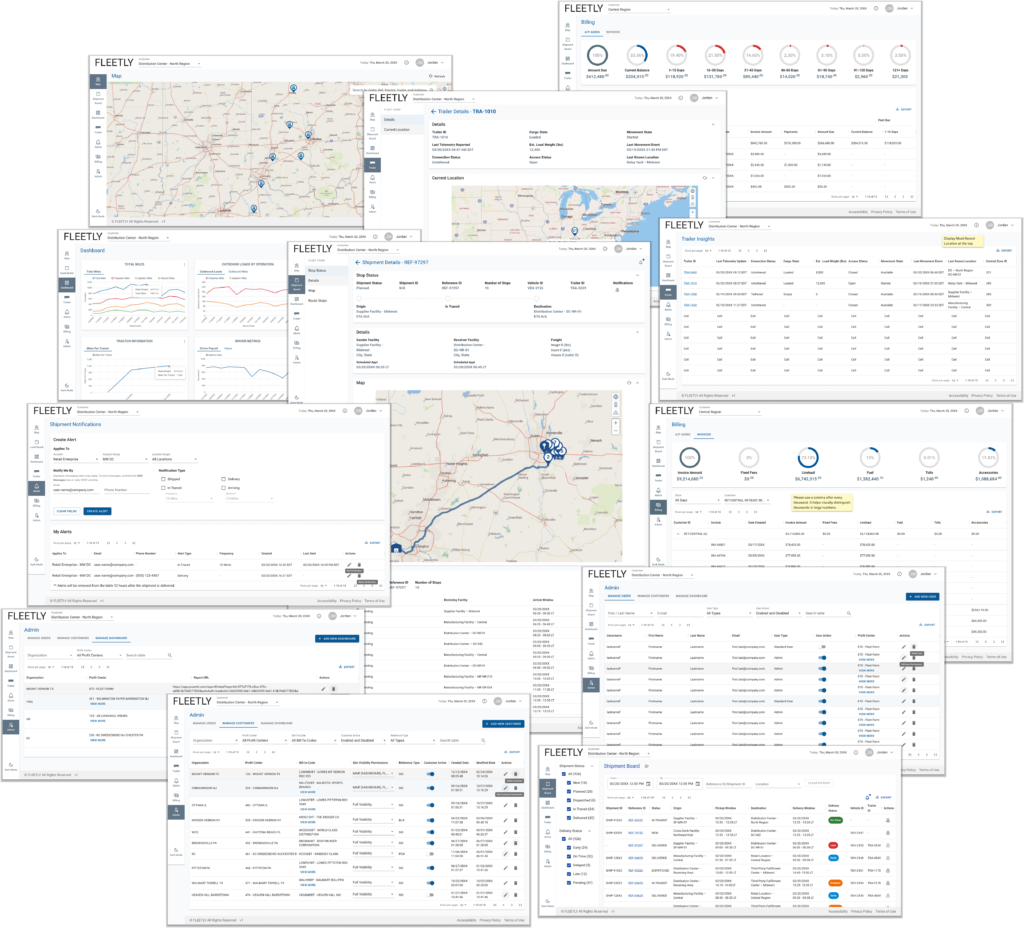
Core Platform Capabilities
Real-time Shipment Visibility
Track truck locations on an interactive map and monitor delivery status through the shipment board.
Operational Dashboards
Provide a high-level view of logistics activity, helping teams quickly understand shipment performance and operational trends.
Fleet & Trailer Insights
Monitor trailer utilization and equipment activity across the transportation network.
Alerts & Notifications
Receive automated alerts when shipment events or status changes require immediate attention.
Billing & Financial Transparency
Manage invoices and monitor outstanding balances through A/P aging and billing dashboards.
Administration & System Configuration
Manage users, customers, and dashboard configurations through a centralized admin interface.
My Role
As the sole designer, I defined the platform’s design direction while establishing foundational patterns that would support future design team growth.

Key responsibilities included:
- Owning the end-to-end product design strategy for a 0→1 enterprise logistics platform, shaping the product vision and translating operational requirements into scalable UX solutions.
- Architecting the platform’s information architecture and core workflows, unifying shipment tracking, fleet insights, billing, and administration into a cohesive system.
- Establishing a scalable design foundation using MUI, creating consistent UI patterns that enabled faster development and long-term product scalability.
- Leading cross-functional collaboration with engineers, product managers, and business analysts, aligning technical constraints, operational needs, and user experience.
- Mentoring engineering partners on UX principles and interaction patterns, ensuring implementation maintained usability, accessibility, and design consistency.
WHY & WHAT
The Challenge
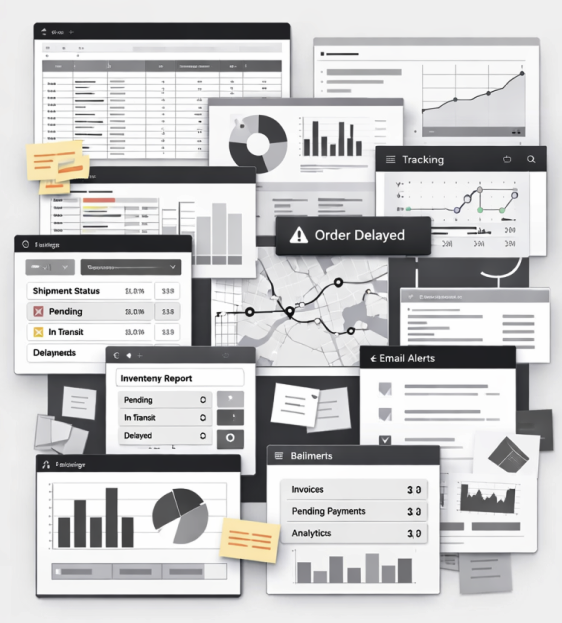
Logistics operations teams relied on multiple disconnected systems to track shipments, monitor alerts, and verify billing. Critical operational data was scattered across tools, forcing users to constantly switch contexts to answer simple questions.
This fragmentation slowed operational decision-making and made it difficult for both customers and internal teams to get a clear picture of transportation activity.
Operational Pain Points
- Shipment tracking, billing, and alerts lived in separate systems
- Users constantly switched between tools to verify shipment status
- Billing visibility was limited and difficult to reconcile
- Administrative tasks required navigating multiple platforms
Teams needed a unified platform that could bring operational visibility, billing insights, and system administration into a single interface.
HOW
The Solution
To address the fragmentation across operations, analytics, and business workflows, I designed Fleetly as a unified logistics operations platform.
The solution focused on structuring the product around the core needs of transportation teams: real-time operational visibility, performance insights, and business management tools.
Rather than organizing features as isolated tools, the platform was designed as a layered system that supports how logistics teams monitor shipments, evaluate performance, and manage operational workflows.
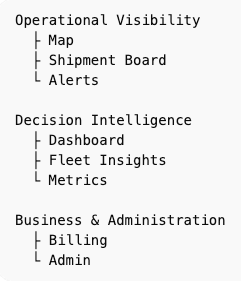
The following architecture illustrates how the platform was structured.
Platform Architecture
Operational Visibility
Provides real-time awareness of transportation activity across the network.
Includes:
Map (truck location tracking)
Shipment Board
Alerts
Answers the question:
Where is the shipment and what is happening right now
Decision Intelligence
Surfaces operational insights to help teams evaluate performance and take action.
Includes:
Dashboard
Trailer insights
Operational metrics
Answers the question:
How is the operation performing?
Business & Administration
Supports the financial and administrative workflows required to operate the platform.
Includes:
Billing (A/P aging and Invoices)
Admin (users, customers, dashboards)
Answers the question:
How do we manage the business side of logistics?
Service Blueprint
Connecting customer experience with business operations
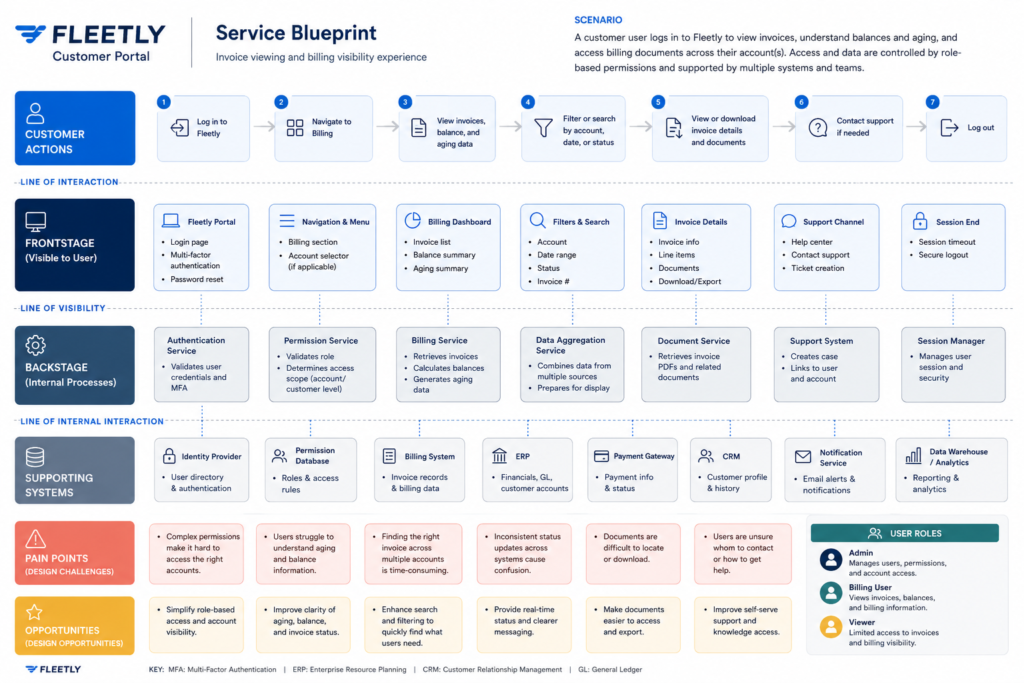
Before designing the interface, I mapped the end-to-end billing service to understand how users, internal teams, and supporting systems interacted. This service blueprint visualizes the complete experience, from customer actions to backstage processes and operational dependencies. It became a shared artifact for aligning product, engineering, and business stakeholders around a common understanding of the service.
Mapping the service early exposed system dependencies, role-based permissions, and complex billing workflows before detailed interface design began. This reduced ambiguity and helped teams make informed design and technical decisions throughout the project. The result was a more intuitive, scalable experience that balanced user needs with business and operational requirements.
Core Interfaces
Operational Control — Shipment Management
Purpose
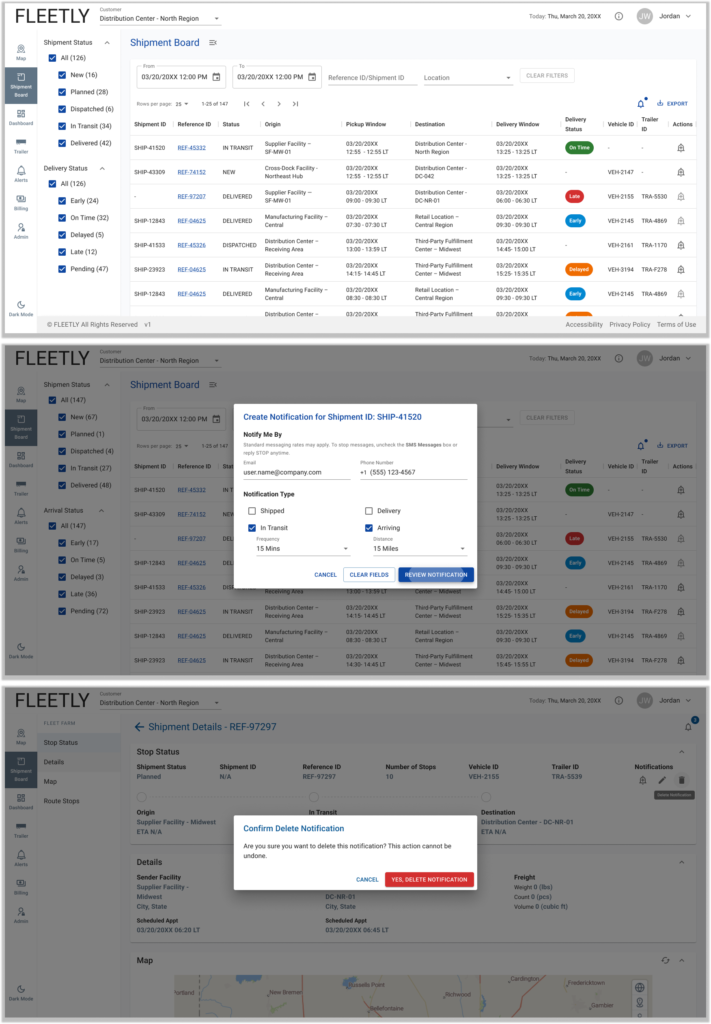
The Shipment Board serves as the operational command center for logistics teams. It allows dispatchers and operations managers to monitor shipment status, identify issues, and take action without navigating across multiple tools.
Design Decisions
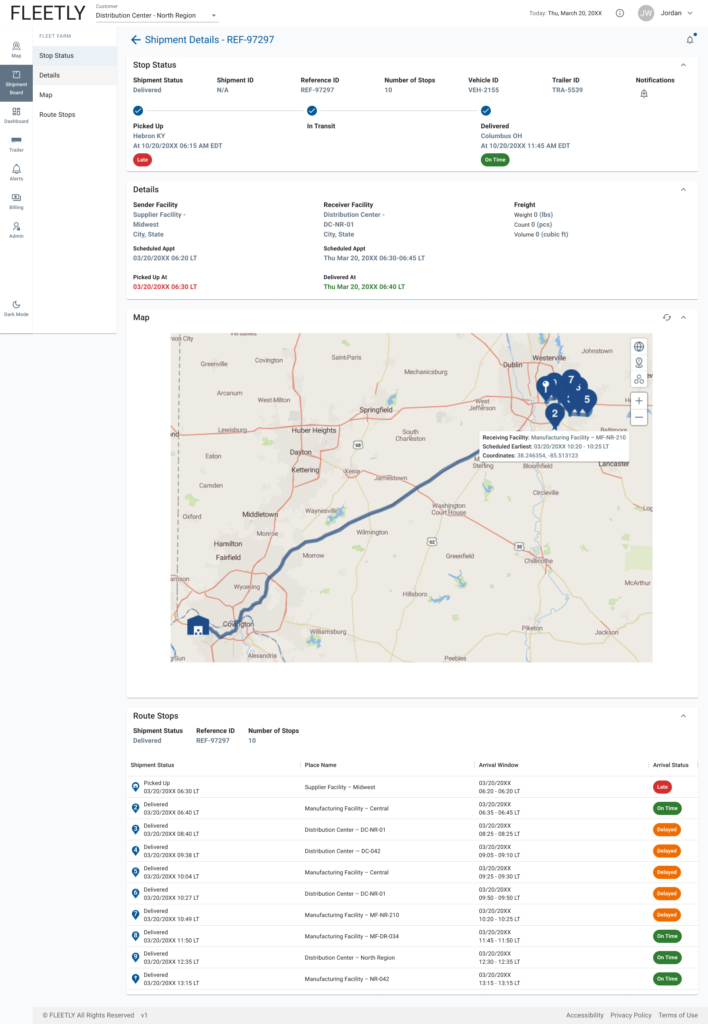
The interface prioritizes rapid scanning and operational awareness. Shipments are displayed in a structured table with status indicators, enabling users to quickly detect delays, exceptions, or delivery updates.
Filtering controls allow teams to isolate shipments by reference ID, location, or delivery state, supporting faster investigation and operational triage.
Selecting a shipment reveals detailed information and route context, allowing users to move seamlessly from monitoring activity to investigating a specific shipment.
UX Principles Applied
- Information hierarchy — Key shipment attributes such as status, origin, destination, and delivery timing are prioritized for quick interpretation.
- Jakob’s Law — The table layout follows familiar enterprise SaaS patterns, reducing learning time for operations teams.
- Hick’s Law — Actions are intentionally limited to reduce cognitive load when scanning large volumes of shipments.
- Progressive disclosure — Detailed shipment information appears only when a user drills into a shipment.
Error Prevention
Critical actions such as deleting a notification require confirmation dialogs. This prevents accidental destructive actions and ensures that users have an opportunity to review their decision before proceeding.
Accessibility Considerations
Status colors are paired with text labels to ensure clarity for users with color vision deficiencies. The table structure supports keyboard navigation, and consistent spacing improves readability in high-density data views.
Financial Operations — Billing Transparency
Purpose
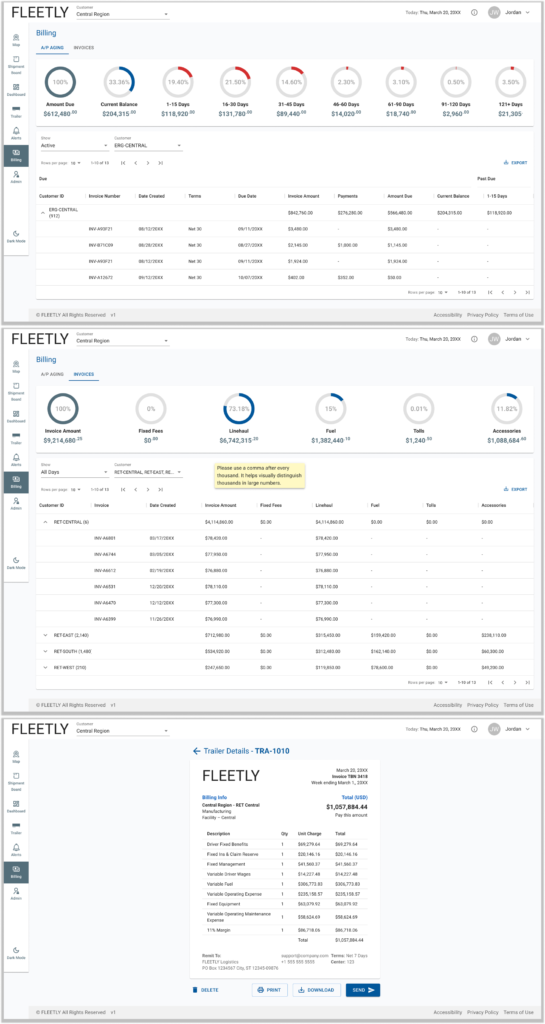
The Billing interface provides operations and finance teams with clear visibility into invoices, outstanding balances, and aging accounts. The goal was to reduce the time required to reconcile shipment activity with financial records.
Design Decisions
Financial summaries are surfaced at the top of the interface using visual indicators to quickly communicate aging balances and payment status. This allows teams to identify overdue accounts or financial risk without reviewing individual invoices.
Detailed invoice tables provide drill-down access to billing records, enabling users to move from high-level financial overviews to individual transaction details.
The invoice view presents a structured breakdown of charges, supporting verification, reconciliation, and communication with customers.
UX Principles Applied
- Information hierarchy — High-level financial indicators appear before detailed records to support rapid financial assessment.
- Progressive disclosure — Users begin with summary insights and can explore invoice details when deeper investigation is required.
- Consistency — Financial tables follow the same interaction patterns as operational shipment data, reducing cognitive switching between workflows.
Accessibility Considerations
Financial indicators combine color with numeric values to ensure clarity for users with color-vision deficiencies. Table structures support keyboard navigation and maintain consistent spacing for readability in high-density data environments.
Platform Governance — User Administration
Purpose
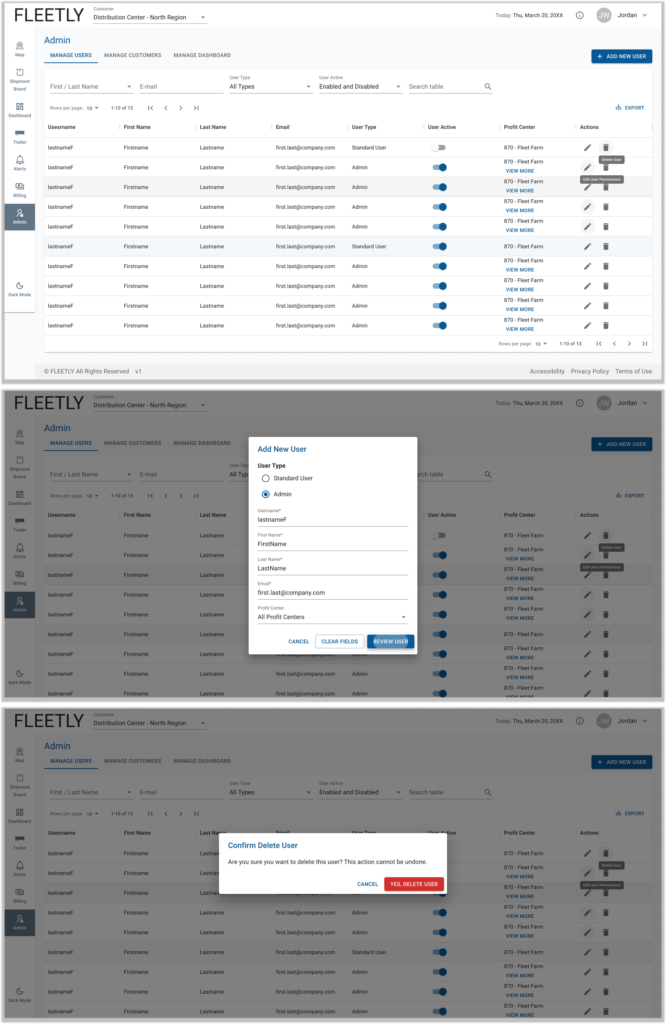
The Admin interface allows organizations to manage users, assign roles, and control access to the Fleetly platform. Centralizing these tools ensures that operational teams can maintain system security and user governance without relying on external tools.
Design Decisions
User accounts are displayed in a structured table that enables administrators to quickly review permissions, activation status, and organizational assignments.
Role selection and user creation are handled through a guided modal workflow, allowing administrators to add users without navigating away from the management screen.
Administrative actions such as editing permissions or deleting users are clearly surfaced while maintaining safeguards to prevent accidental configuration changes.
UX Principles Applied
- Role-based structure — Users can be assigned different permission levels (e.g., standard user or admin) to control access across the platform.
- Consistency — Administrative tables follow the same interaction patterns used throughout Fleetly, reducing cognitive switching between operational and configuration workflows.
- Error prevention — Destructive actions such as deleting users require confirmation dialogs to avoid accidental system changes.
Accessibility Considerations
Toggle controls, form inputs, and table layouts support keyboard navigation and maintain consistent spacing and labeling to ensure administrative workflows remain accessible across complex configuration tasks.
Design System & Platform Scalability
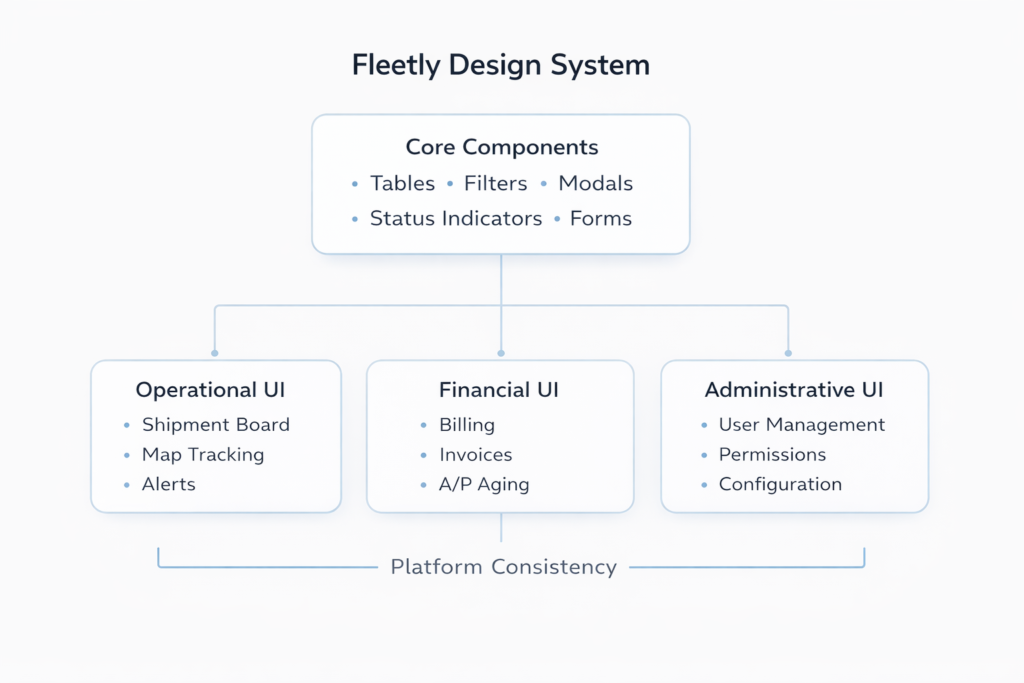
Fleetly was designed as a scalable enterprise platform supporting multiple operational workflows, including shipment monitoring, financial management, and administrative configuration.
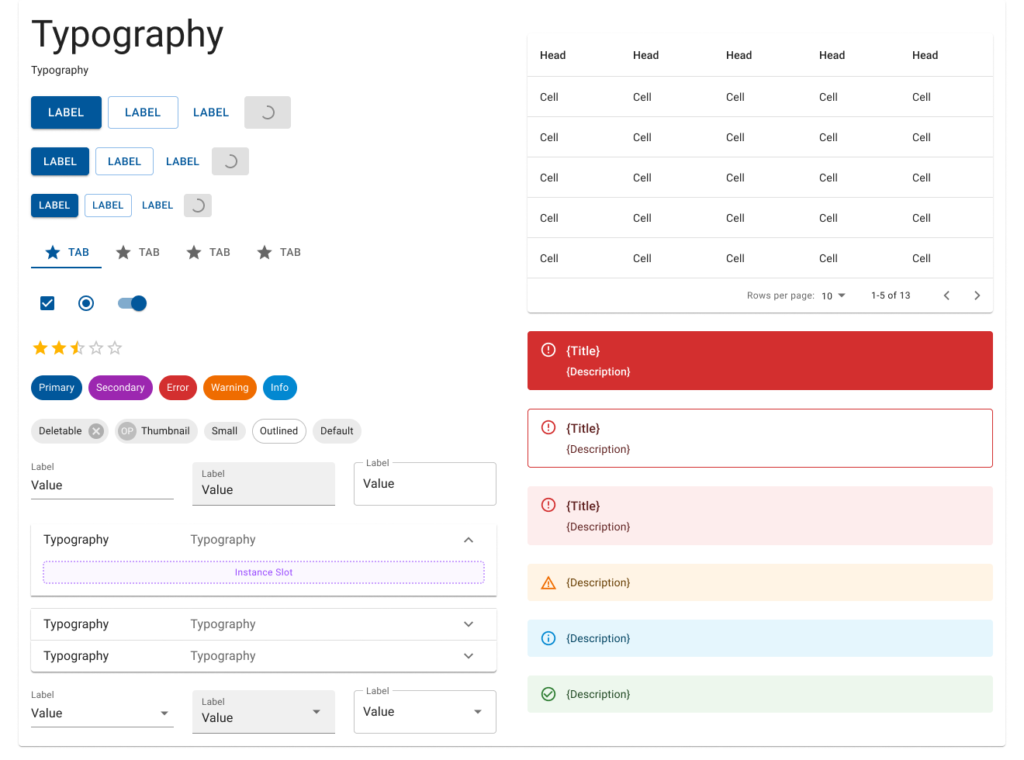
To ensure consistency and long-term maintainability, the interface was built using the Material UI (MUI) component framework. A shared component foundation allowed interaction patterns to remain consistent across operational, financial, and administrative modules.
Reusable UI components such as tables, filters, status indicators, and modal workflows were standardized across the platform. This reduced development complexity while allowing users to move between workflows without relearning the interface.
Accessibility considerations such as keyboard navigation, clear hierarchy, and consistent spacing were incorporated directly into the component structure, enabling the platform to scale across high-density data environments.
Fleetly’s design system enabled consistent interaction patterns across operational, financial, and administrative workflows.
Bringing It All Together
Fleetly unified multiple operational tools into a single platform, enabling operations teams to monitor shipments, manage billing, and administer system users without switching between systems.
By consolidating operational visibility, financial transparency, and administrative controls into one interface, the platform reduced context switching and improved decision-making across logistics teams.
This integrated approach helped teams respond faster to shipment issues, maintain clearer financial oversight, and manage organizational access from a centralized environment.
VALUE
Impact
Fleetly unified shipment tracking, financial visibility, and system administration into a single enterprise platform. By consolidating previously fragmented logistics workflows, the platform eliminated the need for operations teams to move between multiple tools to manage transportation activity.
Operations teams could monitor shipment status, track financial performance, and manage system users within one interface. This improved operational awareness and enabled faster decision-making during active delivery windows.
By structuring operational data through dashboards, shipment boards, and billing views, the platform made complex transportation activity easier to understand and manage at scale.
Key Outcomes
- Unified workflows across shipment tracking, billing, and administrative operations
- Reduced operational context switching between logistics systems
- Improved visibility into transportation activity and financial performance
- Faster issue detection through centralized alerts and shipment monitoring
- More confident operational decision-making during delivery windows
Operational clarity isn’t just about seeing data.
It’s about giving teams the confidence to act on it.
REFLECTION
Lessons Learned
Designing Fleetly reinforced the importance of thinking beyond individual screens and designing enterprise products as interconnected systems.
In logistics operations, shipment tracking, financial oversight, and administrative controls are tightly connected. Designing these workflows together ensured that the platform reflected real operational processes rather than isolated product features.
The project also highlighted the value of scalable interaction patterns. Standardizing tables, filters, and status indicators through a shared component system helped maintain consistency across complex operational workflows while supporting future product growth.
Most importantly, the project demonstrated how thoughtful product design can simplify complex operational environments while still supporting the scale and flexibility required by enterprise teams.
FINAL THOUGHT
My Design Philosophy
I believe enterprise platforms succeed when clarity, consistency, and operational insight come together. In high-stakes environments, users are often making decisions that affect real-world operations and financial outcomes.
My role as a product designer is to transform complex systems into interfaces that help teams understand what is happening, identify what matters, and act with confidence.
Design is not just about creating interfaces; it is about building systems that align user needs, operational workflows, and business goals into a cohesive experience.