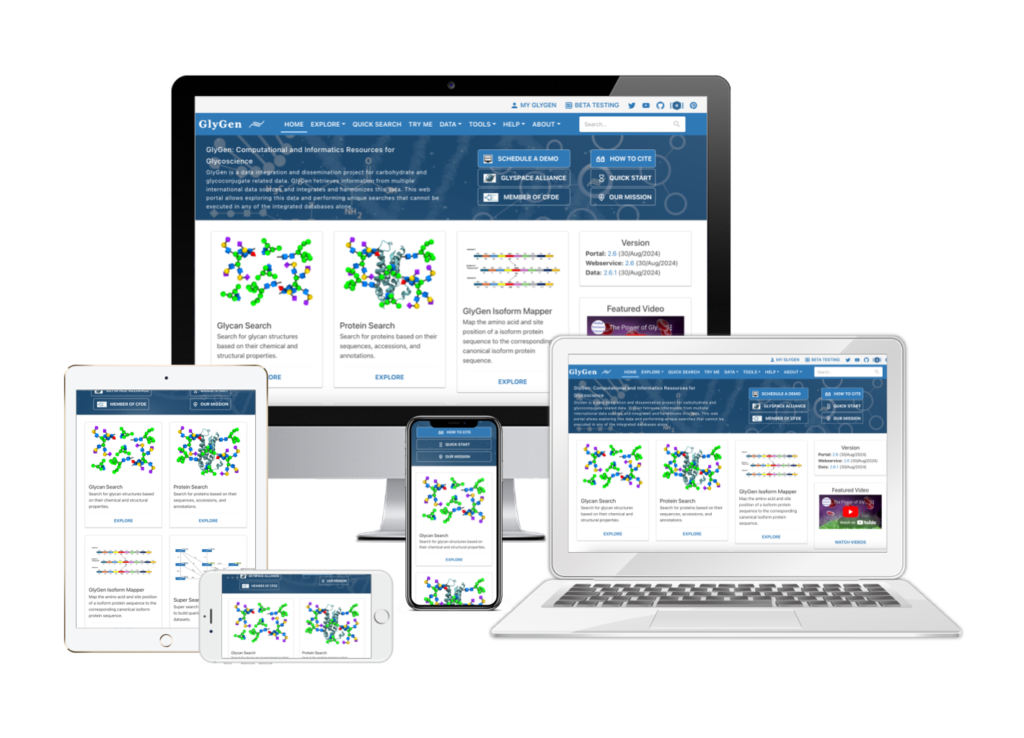
Glycoscience researchers often rely on fragmented data sources spread across multiple databases. I helped design GlyGen, an NIH-funded platform that unifies biological datasets and research tools into a single computational resource for scientific discovery.
My Role: Product Design Lead | 0→1 | UI Engineering | Visual Design | Marketing
Unified Scientific Data Platform
Consolidated fragmented glycoscience databases and research tools into a single platform, simplifying how scientists access and analyze complex biological data.
Accelerated Scientific Workflows
Reduced the time required to locate and analyze research data by 50%, allowing scientists to complete key research tasks significantly faster.
Increased Research Engagement
Improved platform usability and navigation, contributing to a 40% increase in user engagement as researchers spent more time exploring datasets and analytical tools.
Global Research Accessibility
Created an intuitive data platform adopted by researchers worldwide, making critical glycoscience resources easier to access, understand, and apply in scientific discovery.


WHY
The Problem
Prior GlyGen
Before GlyGen.org, researchers in glycobiology had to navigate multiple, often difficult-to-use platforms to complete one project. This not only significantly slowed down their work but also complicated their research and created confusion and inefficiency.
The Need
GlyGen.org, funded by the National Institutes of Health (NIH) and developed at the University of Georgia along with other universities, needed to solve this problem by creating a single, user-friendly platform that combined everything researchers needed into one place.
The Mission
The mission was to simplify access to critical data and essential tools, enabling scientists to focus on their research rather than struggling with complex technology. This approach would ultimately boost research speed through data-driven design.


WHAT
My Role and Responsibilities
As the lead designer and engineer, I was responsible for building GlyGen.org from the ground up, focusing on both the look and feel of the platform, as well as how it worked. I collaborated closely with stakeholders, leadership, the data integration team, and a team of four developers to turn the vision into a fully functional website.
Key responsibilities included:
- Conducting user research to understand the challenges scientists faced when using multiple platforms
- Designing the user experience (UX) and user interface (UI) from scratch, creating a solution that was intuitive and easy to use
- Ensuring the design was accessible and scalable, so scientists from around the world could easily access the platform
- Working directly with developers to ensure the design translated smoothly into a working product
HOW
The Solution
The solution was to build GlyGen.org as a one-stop platform that combined all the tools and data researchers needed in one place. This allowed scientists to access everything they needed quickly and easily, without switching between multiple confusing platforms.


I led the design of this platform with the belief that
Great design doesn’t just look good; it solves problems.
GlyGen.org is a perfect example of how design can simplify complex tasks and support real-world progress.


VALUE
Impact and Results
From Concept to Completion: The launch of GlyGen.org transformed the way researchers accessed and used scientific data.
The new platform didn’t just make their work more efficient—it helped advance scientific research by making critical data more accessible to the global scientific community.
40% increase in user engagement
Researchers were spending more time on the platform, finding the tools and data they needed more quickly.
50% reduction in the time it took to complete tasks
By combining everything in one place, the platform drastically reduced the time scientists spent searching for information.
Positive global feedback
Researchers from around the world appreciated how much easier and faster it was to use GlyGen.org compared to their old systems.
LESSONS
Lessons Learned
This project taught me how essential it is to simplify complex processes for users. By taking the time to understand the real challenges researchers faced, I was able to design a platform that genuinely improved their workflow. I also learned the value of close collaboration with developers, ensuring that the design and functionality worked hand in hand.
FINAL THOUGHT
Personal Value Proposition
Through the creation of GlyGen.org, I demonstrated my ability to build a complex platform from scratch, bringing together research, design, and development to create a seamless user experience. This project reflects my personal mantra—“Great design doesn’t just look good; it solves problems”—and shows how I can deliver high-impact solutions that make a real difference in the lives of users.